Monday, August 24, 2015

Welcome back, students!

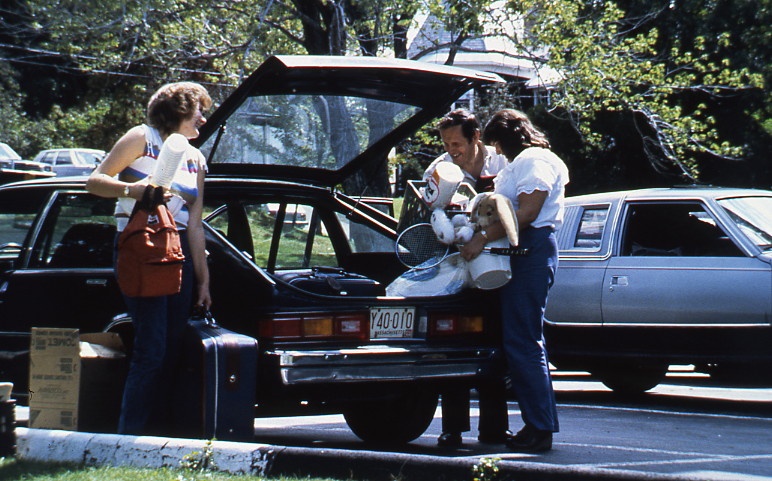
Here at the Champlain College Library, and across campus, we are looking forward to our students' return at the end of August. The College Archives contains many images documenting the annual ritual of move-in day, which has occurred on campus since our first dormitory, Jensen Hall, opened in 1965. Here are a couple of good shots from the recent past:

Unpacking the car, c. 1980, Champlain College Archives


Moving in to Rowell Hall, by Kathleen Landerwehrle, 1999, Champlain College Archives

(Check out the Gateway computer!)

Monday, April 27, 2015

Champlain's Ethan Allen Center

The history of Champlain's ETHAN ALLEN CENTER is featured in a new special collections exhibition in the lobby of Miller Information Commons. In 1857, a group of local businessmen founded the Ethan Allen Fire Engine Company No. 4, a volunteer firefighting and men's social organization. The Company drew its name from its first horse-drawn fire engine, dubbed the "Ethan Allen" in honor of the colonial leader of the Green Mountain Boys.

In 1889, the Company built a firehouse on Church Street, now Burlington City Arts' Firehouse Gallery. This postcard view from the early twentieth century shows the firehouse next to Burlington's old City Hall (which was replaced in 1928).

Postcard view of City Hall showing the Ethan Allen Firehouse in the background, c. 1910-1920
Llewellyn Collection of Vermont History, #2010.1.620
After a series of devastating fires in 1895, Burlington residents voted to form a paid Fire Department, rendering the city's volunteer firefighting companies, including the Ethan Allen Company, obsolete. The Ethans vacated their firehouse and reinvented themselves as the Ethan Allen Club, a purely social organization. By this time, the Club had about two hundred members, among them prominent businessmen, bankers, and politicians. In 1905, the Club purchased and renovated an elegant Greek Revival style house on College Street dating to 1834 for its new clubhouse. It contained reception and banquet rooms, a basement bowling alley, billiards room, and a caretaker's apartment.


Postcard view of the Ethan Allen Club at 298 College St., Eastern Illustrating and Publishing Co., postmarked 1917
Llewellyn Collection of Vermont History, #2010.1.477

In 1971, the clubhouse was destroyed by a fire caused by faulty electrical wiring. The Club immediately rebuilt the clubhouse, constructing a modern brick building:

The rebuilt Ethan Allen Club, detail of the front cover of History of the Ethan Allen Engine Company No. 4 (1982)
Llewellyn Collection of Vermont History, #2010.1.821
After the Club disbanded in 2008, Champlain College purchased the clubhouse for eventual redevelopment as student housing. In the meantime, the building has been reimagined as the Ethan Allen Center and is currently being used for as a pop-up museum showcasing student work.

Monday, April 6, 2015

Champlain College: Empowering Women Since 1878

NEW RESEARCH INTO THE EARLY HISTORY of Champlain College has revealed that the College has admitted women since its establishment in 1878. Champlain was founded as the Burlington Collegiate Institute and Commercial College, a private, for-profit school offering professional business training and college prep classes. An advertisement for the 1878-1879 school year boasts:  “This institution offers unsurpassed facilities to either sex to obtain a thorough education in either English commercial or classical branches, and prepare students also for any first-class college.”

A coed classroom at Champlain College (then known as the Burlington Business College), c. 1905
Courtesy Dean Howarth, Class of 1968

In the late 1870s, only about thirty percent of American colleges and universities admitted women. What is more, the very concept of higher education for women –much less coed higher education –was still very much a matter of debate. In 1873, only five years before Champlain was established, Boston physician Edward Clarke argued that higher education for women on a level equal to men’s should be discouraged, as rigorous intellectual activity would deplete their health and ability to have children. Clarke proposed that a separate, watered-down curriculum be designed for women.

Yet commercial colleges like Champlain College were a different beast than traditional four-year undergraduate institutions. They provided a comparatively short-term, economical, and practical course of study that primarily attracted students from the lower and middle classes. Starting in the 1840s, hundreds of commercial colleges were established across the country as the growing economy led to an increased demand for office workers trained in bookkeeping, penmanship (for legible business correspondence), stenography (shorthand), and later, typing and telegraph and telephone operation. Commercial colleges appealed to many nontraditional students seeking entry into the developing clerical field:  young men with limited means or education, veterans returning from military service, workers aspiring to move up the career ladder, and, by the 1870s, women who needed to earn a living.

Office work, particularly entry-level secretarial positions, provided new professional opportunities for women – appealing alternatives to the primary occupations open to them for much of the nineteenth century: domestic service, sewing, textile machine operation, and teaching. As a result, female students were an important demographic for commercial colleges, most of which were coed by the 1870s.


Illustration from a 1916 Champlain College [Burlington Business College] brochure
Champlain College Archives


Female enrollment in commercial colleges increased dramatically in the last three decades of the nineteenth century, mirroring the growing acceptance of women stenographers, typists, and bookkeepers. Nationally, 15% of commercial college students were female in 1882, and that had risen to 34% by 1898. In 1885, the earliest year for which Champlain’s enrollment details are known, only 9 out of 62 students, or 14.5%, were women. In 1898, 41 out of 98 Champlain students, or 42%, were female. It is clear that in the late nineteenth century, Champlain offered important educational opportunities for women, empowering them to enter the business world and begin to chip away at its glass ceiling. 

- Erica Donnis, Special Collections Director
Friday, April 3, 2015

Children’s Bibliotherapy Display

Children’s books aren't always humorous – the books on display on the 3rd Floor of MIC demonstrate that children’s literature can also be powerfully healing for young ones who have experienced a difficult event. This beautiful collection showcases some of the library’s picture books about divorce, loss, adoption, illness, and unexpected change. To learn more about bibliotherapy, visit http://bibliotherapy.ehs.cmich.edu/ or come talk with a Reference Librarian!

Tuesday, March 31, 2015

Second Annual Edible Books Festival!

These books are literally delicious
Swing by the main floor of the library this Wednesday, April 1st from Noon-3:30pm for the second annual Edible Books Festival

The Edible Books Festival an international, multi-media, participatory creative event which invites us all to a “world banquet where delicious, surprising bookish foods will be consumed.” Playful and provocative, the festival explores the integration of food with “text, literary inspiration or, quite simply, the form [of the book].” 

You can vote for your favorite and eat the books and other snacks at the serving celebration at 3pm! 

Prizes will be awarded in the following categories: 
  • Prettiest 
  • Punniest 
  • Best Biblically Themed (in honor of the St. John's Bible)
  • People’s Choice
Want to know more about edible books? Check out these links: http://www.books2eat.com/ and http://www.books2eat.com/index.php?page=albums

To see last year's entries check out our Facebook Album

Contact Stephen Wehmeyer with any questions. Bon Appetit!

Friday, March 27, 2015

Getting Around Town (and other places): How the People of Burlington Travelled

A new Special Collections exhibit has been set up at Roger H. Perry Hall depicting three main ways of travel in, around, and through Burlington, Vermont.

The most popular way to travel back in Burlington’s earlier days was by steamboat. It’s no surprise that mode of transportation was a huge hit because of Burlington’s location right on Lake Champlain. The most famous steamboat to run on the lake was the Ticonderoga, built in 1906, but sadly went out of business in 1950s due to more efficient ways to travel and has since retired to the Shelburne Museum.

Postcard of Steamship Ticonderoga docked in Burlington by Jesse Sumner Wooley, postmarked 1908
Llewellyn Collection of Vermont History, 2010.1.663

Another popular way to go from one place to another was by train. Even though the routes were mainly used for lumber transportation from the 1850s to the early 1900s, travelers used the Union Depot's services to travel from Burlington to other places in Vermont and New York. About fifty years later the Union Depot was replaced by the Union Station, built in 1915, and continued to carry passengers until passenger train service was discontinued in 1953.

Postcard of newly-completed Union Station by Charles H. Bessey, c. 1914-1915
Llewellyn Collection of Vermont History, 2010.1.664

The most recent way of transport introduced to Burlington is flight service. The Burlington Municipal Airport opened in 1920 and began to expand a few years later when flying became more popular. In
1960, the name was changed to the Burlington International Airport by the Board of Alderman, the
airport received its first commercial flight client, and more flights started to come in.

Stop by the postcard alcove at Roger H. Perry Hall to learn more about Burlington’s fascinating ways of transportation from the Llewellyn Collection of Vermont History.

-Adrian Taul, Class of 2018

Wednesday, March 4, 2015

Wells, Richardson, & Company: Master Advertisers

WELLS, RICHARDSON & COMPANY ranks as one of Burlington's most successful businesses ever. A new Special Collections exhibition in the historic conference rooms of Roger H. Perry Hall, on view through May 2015, profiles the company, its products, and its adept advertising methods. 

Founded in 1872, the pharmaceutical firm produced medicines, infant formula, fabric dyes, and other household products. By 1894, Wells, Richardson had $2 million in annual sales (some $51 million in today’s dollars), employed more than 200 people at its Burlington manufacturing plant and offices, and had branches in London, Montreal, and Sydney. 


Bottling Paine's Celery Compound at the Wells, Richardson manufacturing plant between College and Main Streets, from Burlington in Brief, c. 1890 (Llewellyn Collection #2010.1.456)

Wells, Richardson was a master of advertising, offering free samples, a satisfaction guaranteed policy, consumer testimonials, and cutie-pie images of babies and kids, among other techniques. The company's print department churned out hundreds of free publications designed to appeal to its target audiences, all of them loaded with product ads. This booklet containing a sentimental tale illustrated with sweet little girls, targeted female consumers in the market for fabric dyes such as the company's "Diamond Dyes":


Diamond Dyes: A Tale of Four Children Merry & Wise 
Wells, Richardson & Co., 1904 (Local History Collection #2014.15.1)

Stop by Perry Hall Rooms 274 and 271 to view these items from Champlain's Special Collections, and plenty more, in person.

Tuesday, February 24, 2015

Get Your Leisure On: New Popular Fiction & Nonfiction Books!


Looking for something good to read? The MIC has got you covered! From beach reads to award-winning fiction, celebrity memoirs to titles of local interest, the Popular Books collection is the home for new books that are buzzing. We're excited to announce the inauguration of our Popular Books reading section on the first floor of the library. These shelves are located in the nook next to the Tower Room, which is on your left as you're entering the library. 

This collection consists of recent Fiction and Nonfiction selected by our team of librarians to help keep you entertained. The collection will be added to monthly with new publications, so you will see these shelves fill up throughout the year with great new books. A few titles from our initial run include:

Fiction

Nonfiction 
How to Fly a Horse by Kevin Ashton 

You can find a complete, updated list on our Popular Books LibGuide: http://subjectguides.champlain.edu/popular

Check back often for new titles. If you have suggestions, let us know! 

Monday, February 16, 2015

Superheroes Unite in Champlain College Library

Champlain College librarians have so much fun adding books to our collections, because sometimes we get to choose some titles about superheroes!

Whether you're studying COR 270 - Heroines & Heroes, psyched for Scott McCloud's talk next week or just looking to brush up on your superheroes, Champlain College Library has you covered.

We've highlighted some of our awesome, superhero books in a fun display this month. Check it out next time your in the MIC.

Monday, January 12, 2015

College Dorm Life in the 70s and 80s: Images from the Archives

BEFORE SMARTPHONES, iTunes and laptops, Champlain students had typewriters, record and cassette tape players, and shared pay phones. A new mini exhibit of images from the College Archives, on display this semester on the first floor of Miller Information Commons, highlights College dorm life in the 1970s and 1980s.

Besides the technological differences, life on campus was more regulated -- especially for women. Dorms were single-sex, students had curfews, and visitors (including fellow students of the same gender) were only allowed in common areas, during certain hours. Resident house mothers, the precursors to today's head residents, enforced the rules. Colleges across the country established strict policies like these following cultural expectations for them to act in loco parentis, or on behalf of parents. Curfews and visitation hours were relaxed by the late 1970s and eventually abolished, disappearing along with pay phones, record players, and typewriters.

Students had fun regardless, and they brought a sense of style to their dorm rooms. The resident of this room decorated her bed and windows with a coordinating rainbow-themed set:

Unidentified dorm room, c. 1980-1985, Champlain College Archives

Stop by MIC to see some great shots of students studying in their rooms, using pay phones, and goofing off together. 

Tuesday, December 9, 2014

Great reads for the holiday!

Stop by the Library and check out our Holiday Reading display!  With finals almost over, and the semester wrapping up, it's the perfect time to curl up with a good book....Happy Holidays from the Library!

Monday, December 8, 2014

The American House fire in downtown Burlington, December 1906

On a bitter cold December morning in 1906, crowds gathered at the corner of Main and St. Paul Streets as a catastrophic fire swept through Burlington's premier hotel, the American House. Local photographer B. Benton Barker rushed over from his studio and home on College Street to capture the scene. He soon published his images of billowing smoke, firefighters, and spectators in a series of postcards that he sold.

"American House Fire, Dec 16 '06," by B. Benton Barker, 
Llewellyn Collection #2010.1.581


According to the Burlington Weekly Free Press of December 20, 1906, the hotel was gutted, and one hotel guest died. Several street-level shops and apartments at the rear of the building were also destroyed. Only a portion of the structure, the eastern section fronting on Main Street, survived the fire; it now contains the Flynn Theatre's FlynnSpace as well as several stores. In 1911, the Hotel Vermont, now the Vermont House, was constructed on the corner site. Another Burlington photographer, Charles H. Bessey, shot the Hotel Vermont soon after its construction was completed.


"Hotel Vermont, Burlington, Vt." by Charles H. Bessey, 1911, 
Llewellyn Collection #2010.1.607

These postcards, and many more, are included in a new exhibit featuring Benton and Barker's work in Perry Hall, which will be on view through early February.

Tuesday, December 2, 2014

Inaugural Ugly Sweater Contest - Judging starts Monday, December 8th at 3pm!

The Inaugural Ugly Sweater Contest

Hosted by the Champlain College Library

In-person competition: Monday, December 8th, 2014 3:00-3:45pm, outside of the Tower Room on the 1st floor

If you can’t make it, compete online! Submit a photo of you in your ugly sweater by tweeting @champlib with #champsweater or post to our Champlain College Library Facebook page with #champsweater! Deadline is Sunday, December 7th at 5pm in order to be included in the slideshow for People’s Choice.

Eligibility: All members of the Champlain College community – students, staff, and faculty alike!

Rules: You must wear a sweater, sweatshirt, or sweater vest. Turtlenecks and long or short-sleeved t-shirts will not be accepted. You may wear such items underneath an ugly sweater/sweatshirt/vest. You may add to or alter your ugly sweater – lights, noisemakers, etc. are all fair game! However, accessories like hats, jewelry or other festive attire will not be considered. An item must be attached to your ugly sweater for eligibility.
You need not be present to win, but in-person participation is encouraged! Winners will be announced in the following categories:
  • General: The Ugliest of All
  • Holiday: Christmas, Halloween, Valentine's Day - you get the picture!
  • People's Choice: Voting for all entries received online and those present onsite will take place in person from 3 to 3:30.
Prizes: We’re offering small gift certificates to several downtown businesses – and of course, bragging rights.

Come for study break goodies and hot cocoa and cider. Take a few minutes to relax, have a laugh, and recharge before diving back into your finals week.

Your humble judges are Andy Burkhardt, Joanna Jordan, and Lindsey Rae (and yes, we’re ineligible, but we just may wear our own ugly sweaters in solidarity!).

Tuesday, November 11, 2014

Celebrating the new David L Cooperrider Appreciative Inquiry Center


On Saturday, Champlain celebrated the opening of the David L. Cooperrider Center for Appreciative Inquiry. Want to learn more about Appreciative Inquiry? Stop by the display at the main desk in Miller Information Commons and check out a book on the topic!

Monday, November 10, 2014

Victory Parade, 1918

Ninety-six years ago, on November 11, 1918, a victory parade was held in downtown Burlington to mark the end of World War I. This postcard from Champlain's Llewellyn Collection of Vermont History commemorates the moment when crowds gathered to watch soldiers march up Church Street. The following year, November 11 would become a national holiday honoring veterans, now known as Veterans Day.

Postcard of 1918 Victory Parade by C.H. Bessey, 
Llewellyn Collection #2010.1.517

C.H. Bessey, the photographer who took this image, was probably standing in an upper-story window of what was then the Ethan Allen Fire House, now the Firehouse Gallery for Burlington City Arts. He aimed his camera down Church Street towards its intersection with Main Street. The three-story building on the corner with the flat roof, the 1876-1877 Exchange Block at 150-154 Church Street, remains standing.

Wednesday, November 5, 2014

Pres. Laackman's Meaningful Books List


Did you miss President Laackman’s book talk? Here are his choices:

Thucydides - Peloponnesian War
Jane Austen - Persuasion
Mark Helprin - Winter's Tale
Neal Stephenson - The Diamond Age
Stephen Covey - Seven Habits of Highly Effective People
Thomas Neff - You're In Charge - Now What?
David Eggers - Hologram for the King
Andrew Solomon - Far From the Tree
Rohinton Mistry - A Fine Balance
William Shakespeare - King Lear

Monday, November 3, 2014

Meaningful Books with President Don Laackman

Join us this Wednesday, November 5th, 2014, 12:15 pm – 1:30 pm Vista Room, Miller Information Commons 

In a 2012 post to his blog Don’s Desk, Champlain President Don Laackman wrote of his quest to read more, “I don’t want to just read more; I want to read more stuff with which I can connect. Books that move me, provoke me and enrich me.”  

Which books are they? Please join us in welcoming President Laackman as our next speaker in the Champlain College Library’s Meaningful Books series. Don will highlight a set of titles that have been especially influential in his career and life. 

About Meaningful Books: Several years ago, Professor Jim Fry suggested that the Library host displays and “books talks” showcasing members of the Champlain College community and their choice of books: books they have found insightful, influential, current, or just plain entertaining. Over the years, College faculty and staff members have shared their most meaningful reads, inspiring all of us to think more about our own reading, both past and future. 

Note: Seating is limited and will be on a first-come, first-served basis, with a room capacity of about 25 people.

Thursday, October 30, 2014

DISPLAY: HAPPY HALLOWEEN

Happy Haunting everyone. We love Halloween here at the Miller Information Commons! Stop by and check out our wonderful display of  books about ghosts, witches, monsters and other frightening creatures. Be sure to grab a  Halloween button and a bookmark on the table near the display. And remember.... Read something spooky and have a safe and wonderful Halloween! Check out a few links below on Halloween:


Halloween


Halloween facts...

Halloween Fantasy and Folklore

Image result for Halloween image


Wednesday, October 29, 2014

7th Annual Library Chili Cookoff!

The days are getting shorter, the leaves are in need of raking, and there’s a distinct chill in the air which can only mean one thing: time for CHILI!

On Thursday, Nov. 6th from 3-4 pm the library is happy to present the 7th Annual Library Chili Cookoff!

There will be categories for best vegetarian, judge's choice, and people's choice. In addition to the chili cookoff, some chefs will also compete in the Fantastic Cornbread Hootenanny.

Come join us in the front Tower Room to eat FREE chili and cornbread and vote for your favorite!


Thursday, October 23, 2014

Open Educational Resources

In yesterday's post, Mike Lange discussed his experiences with open access publication. There is another set of open access information available for faculty: open educational resources.

What is an Open Educational Resource (OER)?
An open educational resource (OER for short) is a curriculum item that is freely available for use. In general, it is released with a more open Creative Commons licensing structure that allows it to be reused and remixed with varying degrees of responsibility for attribution, re-mixing, and sharing. One can even mark an item as "public domain", which means that it is available for use without attribution and can be remixed and shared without breaking copyright.

Where can I find OERs for my courses?
There are a number of great resources available for finding and sharing OERs. Here is just a small sampling:
  • Open4Us.org: Hosted by the Open Professionals Education network, this site is a resource for searching for OERs broken down by material type.
  • OER Commons: This site breaks down OERs by topic. You can also search geographically and by intellectual level. The content is shared under a Creative Commons Attribution-NonCommercial-ShareAlike (CC-BY-NC-SA) 3.0 License unless otherwise noted.
  • Open Education Consortium: This group aggregates content from a number of sources, including MIT's initiative called OpenCourseWare (OCW). 
  • College Open Textbooks: While it does not collect OER textbooks, COT points to the repositories and sites where OER textbooks are located, as well as advocating for creating more open resources for college students in particular.
SPARC has a great resource page to help you learn more about OERs and how to create your own - and how to get support for doing it.

How can I make sure the resources are worthwhile?
Many OERs are peer-reviewed and carefully vetted before they are published in the open access world. As always in the academy, one must be careful to use sound professional judgment about sources; resources from proprietary publishers can sometimes have problems!

Where can I find more?
Many universities have offices devoted to scholarly publishing and open education. While we don't have one at Champlain, we can take advantage of the work that they're doing and publishing on the web.

How might you use an OER in your course or in your classroom? Share your thoughts in the comments!